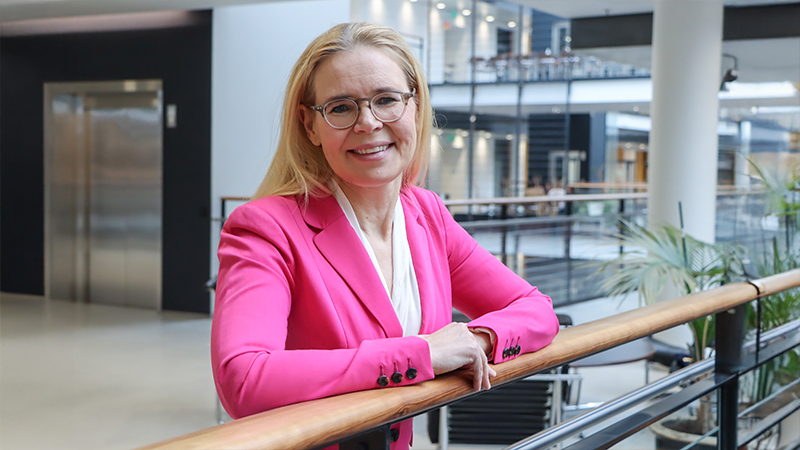
Professor Kirsi Pietiläinen is the 2025 recipient of the European Association for the Study of Obesity (EASO) – Novo Nordisk Foundation Obesity Prize for Excellence for her outstanding work in clinical metabolism. The prize, awarded jointly by EASO and the Novo Nordisk Foundation, includes a DKK 2 million award. Of this, DKK 300,000 is a personal award, while DKK 1.7 million goes to support further research. She is Professor of Clinical Metabolism at the Faculty of Medicine, University of Helsinki, Finland.
Q - Congratulations on winning the EASO Novo Nordisk Foundation Obesity Prize for Excellence Kirsi. Tell us how you felt when you heard the news?
A – Thank you so much. I felt extremely glad and deeply humbled—this kind of recognition is rare and incredibly meaningful. It has truly enlightened and uplifted me every day throughout the spring. This award is not just for me—it reflects the incredible teamwork, mentorship, and collaboration I’ve been privileged to experience throughout my career, as well as the patients who have taken part in our studies.
Q- For our delegates who don’t know you yet, please could you tell us a bit about you – where you are based, and some of the areas of obesity research you are involved in.
A – I’m a Professor of Clinical Metabolism at the Obesity Research Unit, University of Helsinki and also serve as Chief Physician at the Healthy Weight Hub at Helsinki University Hospital. My background is in internal medicine and nutrition, and I’ve been involved in obesity research for over 30 years. With my team at the Obesity Research Unit, we focus on understanding the molecular mechanisms of obesity and various weight loss methods, including obesity medications and bariatric surgery. We are particularly interested in tissue-specific mitochondrial function and novel molecules that can boost this cellular machinery. We’re also working on personalized treatment strategies, ranging from clinical interventions to digital care models. Together with my team at the Healthy Weight Hub, we have developed a large-scale digital coaching platform to support obesity treatment. I’ve had the opportunity to contribute to national guidelines and advocacy efforts in Finland. For me, combining cutting-edge science with compassionate, stigma-free patient care has always been at the heart of this work.
Q – How did you first become involved in obesity research, and what attracted you to the field?
A – I was led into the wonderful world of obesity research by my mentor, Professor Aila Rissanen, who introduced me to the many-sided and complex nature of obesity. Aila was my graduate thesis supervisor of nutrition back in the early 1990s, and it was through her that I first became involved in both obesity research and twin studies. I was privileged to begin my PhD working with twin cohorts established by Professor Jaakko Kaprio, which offered a unique window into the genetic and environmental factors behind obesity. Later, after completing my medical degree, I joined Aila’s clinical research unit, where I had the chance to deepen my understanding of obesity from both a scientific and patient-care perspective. Later, during my clinical work at the hospital, I developed a strong interest in the comprehensive treatment of severe obesity—including bariatric surgery. These early exposures to the biological, psychological, and clinical dimensions of obesity are what truly drew me in—and have kept me inspired ever since.
Q – Your career has involved many different areas in obesity – including advocacy against stigma, much-cited research on the metabolic effects of obesity and various weight loss strategies, and of course some of your most groundbreaking research in identical twins with differences in BMI, that has significantly contributed to how we understand the metabolic effects and complications of acquired obesity.
Is this variety part of the reason why obesity is such an interesting field for research?
A – Yes, very much so. As my wise mentor once said, “Obesity is like life in miniature”—and that idea has stayed with me throughout my career. Obesity is incredibly multifaceted: it involves biology, metabolism, psychology, behavior, and social context all at once. That variety is exactly what makes it such an engaging and important field to study.
It’s a field where you can truly connect molecular science with real-world impact, and that keeps me inspired every day.
Q – Tell our delegates about some projects you are currently involved in.
A- I have the privilege of leading a large, diverse team, and our research truly spans the spectrum—from molecular mechanisms to clinical practice and real-world digital care. We explore the global and tissue-specific metabolic effects of obesity, weight loss, and aging. Our work includes investigating novel molecular pathways to enhance mitochondrial function, such as the role of gut hormones and bile acids. Our next collaborative efforts involve studying cell-type specific functions of adipose tissue. We study the complex interactions between adipose tissue, the liver, and the brain, and examine the key determinants of successful weight loss. We’re also developing AI-based tools to support coaching and improve obesity management in clinical settings. I’m very optimistic for the future, especially when I look at the curiosity and energy of the researchers I work with.
Q – What lectures do you think you might attend at this year’s ECO?
A- The ECO programme is always rich with cutting-edge science, and this year is no exception. I’m particularly looking forward to sessions that highlight advances in metabolism and tissue-to-tissue interactions—areas that are rapidly deepening our understanding of obesity as a whole-body condition. Of course I will attend sessions about adipose tissue – my favourite organ! I'm also excited to hear more about the revolutionary developments in obesity management. It’s inspiring to see how research is moving so quickly from bench to bedside, and I always come away from ECO full of new ideas and energy. And of course, I’ll be cheering on my team members presenting their own work!
Q – Finally an easier question – how do you like to relax away from work?
A – I love being outdoors, especially walking by the sea with my spouse—Helsinki has so many beautiful spots that help clear the mind. Spending time at home with my partner and with family is really important to me, and I make a point to stay connected with friends, whether it’s meeting up or just catching up over the phone. Those moments of connection are what keep me grounded and recharged outside of work.
Thanks Kirsi – congratulations and have a great congress!
Day Two Articles
Day Two Videos
- SURMOUNT-5 NEJM study on Tirzepatide and Semaglutide - Press Conference Highlights
- Watch - EASO-Novo Nordisk Foundation Obesity Prize for Excellence - Professor Kirsi Pietiläinen
- Preview of A New Algorithm for Obesity Treatment: with Professor Barbara McGowan


